Rugby basics
Rugby positions explained for kids: who does what, from 1 to 15
5 min read 15 October 2026
"Where do I play?" is one of the first questions a new player asks. Our Playbook Where Do I Play? (Game Smarts, ages 7–12) answers it with Mia, Leo and their friends on Positions Day.
A team of fifteen
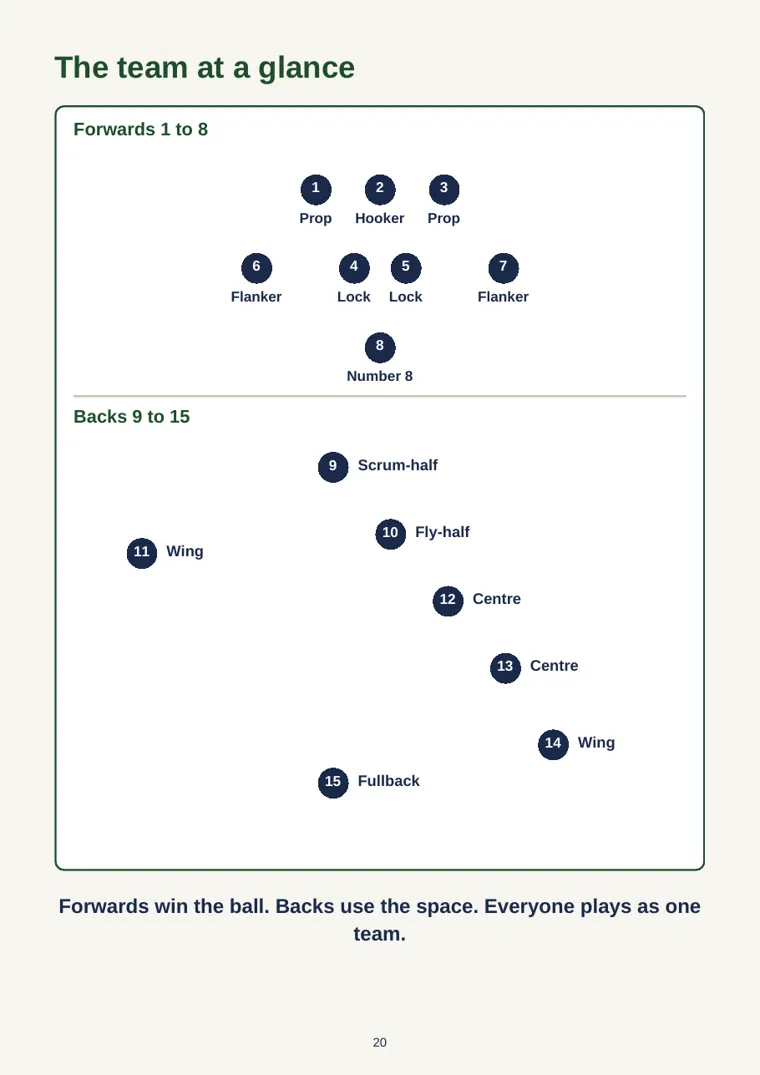
In the full game, a rugby team has up to fifteen players on the field. Each place has a name and a number on the shirt. Junior teams often play with fewer players, and coaches let children try lots of positions. Your club will tell you how your age group plays.
Forwards: 1 to 8
The forwards work close together. They help win the ball and keep it.
- Props (1 and 3): strong and steady, at the front of the scrum.
- Hooker (2): in the middle of the front row. In a scrum, the hooker tries to win the ball with a foot. In a lineout, the hooker usually throws the ball in.
- Locks (4 and 5): behind the front row in the scrum. Often tall, they jump to catch the ball in a lineout.
- Flankers (6 and 7): on the sides of the scrum. They race to the ball, support and defend.
- Number 8: at the back of the scrum, and can pick the ball up from there.
Backs: 9 to 15
The backs spread out across the field. They use the ball and run into space.
- Scrum-half (9): links the forwards and the backs, and gets the ball out quickly.
- Fly-half (10): the decision-maker. Pass, run or kick?
- Centres (12 and 13): in the middle of the backs. They run hard at gaps, pass to the wings, and defend strongly.
- Wings (11 and 14): out wide near the touchlines. Often quick, they finish moves and score lots of tries.
- Fullback (15): at the back. Catches kicks, is the last defender, and joins the attack from behind.
Everybody's job
Every player, in every position, catches and passes, supports the ball carrier, defends and plays fair. Players of every shape and size play in every position. As Coach Dan says: you don't have to choose yet.
A note on safety
Scrums, lineout lifting and tackling are learned at a club, with a coach, when your age group's rules allow. Our book explains what each position does; it does not teach those skills.