
New to rugby? You are not alone. Here are the words young players meet first, in the plain wording we use in our Playbooks.
Scoring
- Try: being first to press the ball down on or over the other team's try line.
- Try line: the line at the front of each in-goal.
- In-goal: the end area where tries are scored, including the try line.
Passing
- Throw forward: a pass that goes forwards. Not allowed. Passes go backwards or level.
- Ball carrier: the player with the ball.
- Support runner: a team-mate behind or level with the ball carrier.
Attack and defence
- Attacking: having the ball and trying to score.
- Defending: stopping the attack and winning the ball back.
- Opponent: a player on the other team.
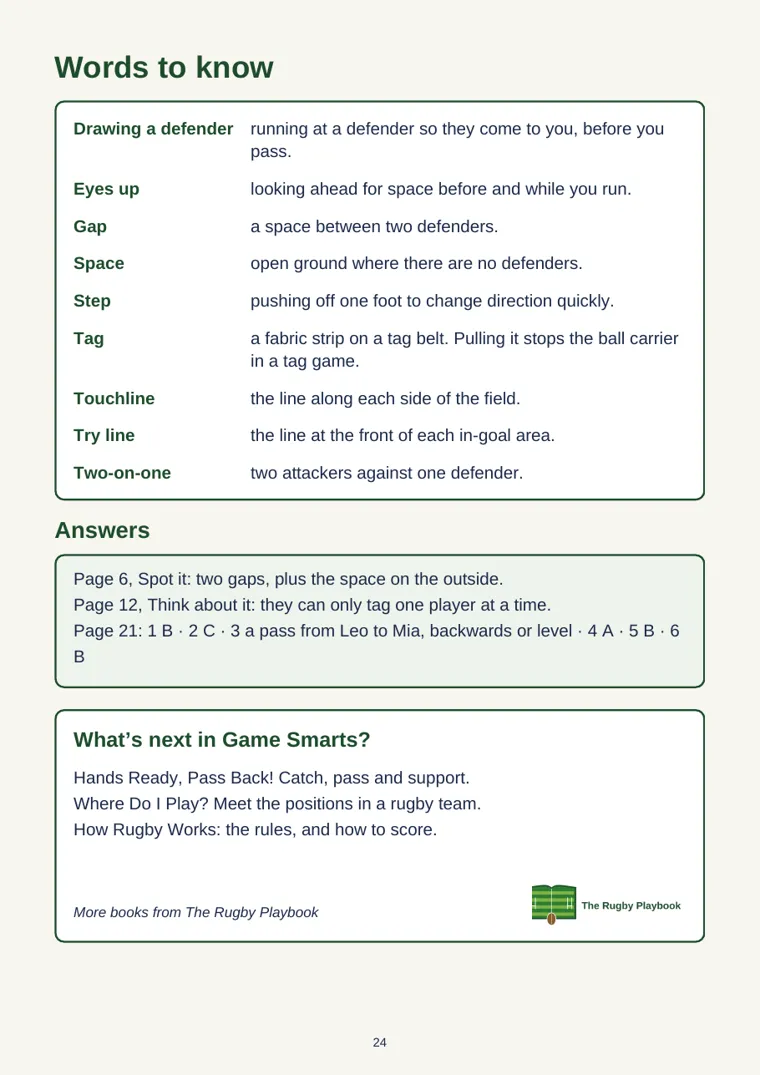
- Space: open ground where there are no defenders.
- Gap: a space between two defenders.
- Two-on-one: two attackers against one defender.
- Drawing a defender: running at a defender so they come to you, before you pass.
- Step: pushing off one foot to change direction quickly.
The field
- Touchline: the line along each side of the field.
Tag rugby
- Tag: a fabric strip on a belt. Pulling it stops the ball carrier in a tag game.
The team
- Forwards: players 1 to 8, who work close together to win and keep the ball.
- Backs: players 9 to 15, who spread out and use the space.
- Scrum: players from each team bound together, pushing to win the ball after a stop in play.
- Lineout: a line of players from each team waiting to catch a throw from the side of the field.
Junior rugby rules vary by country, age and club, so your club is the best guide for how your child's age group plays.